
Checking Clayton County Warrants
The Clayton County Court Case Inquiry comes first. It is not one combined warrant list. It routes you to court record systems, so search the full legal name and add a case number if the system allows. Superior, State, Magistrate, and municipal courts each control their own records. A date of birth helps a clerk separate people who share a name. The sheriff's public name search is a second check. It shows current inmates and recent booking or release windows, not every unserved warrant. Still no answer online? Call the clerk for the court that handled the citation or charge. Custody questions go to the sheriff. Clayton County GovQA handles releasable-record requests. Before any in-person visit, a lawyer can help plan safe next steps.
- Identify the court from the citation, case paper, charge, or prior hearing.
- Use the county case inquiry with a name or case number.
- Check the sheriff docket only for current custody or recent jail activity.
- Call the issuing clerk or request a specific existing record when the web tools do not settle status.
- Ask a Georgia lawyer about recall, bond, appearance, or surrender before going in person.
Clayton County Warrant Docket Limits
The Clayton County sheriff name search opens on Active Inmates. Separate buttons cover 48-hour, 14-day, and 31-day detention windows. Those controls change the period shown, never the list of outstanding warrants.
Key limit: A missing jail result is not written proof that a warrant was never issued or has been recalled.
The sheriff warns that electronic information changes fast and may be incomplete. Printed jail records remain that office's official reference. So treat the online result as one lead. Confirm legal status through the case inquiry, the issuing clerk, or a records request. The official name-search screen shows the limited controls.
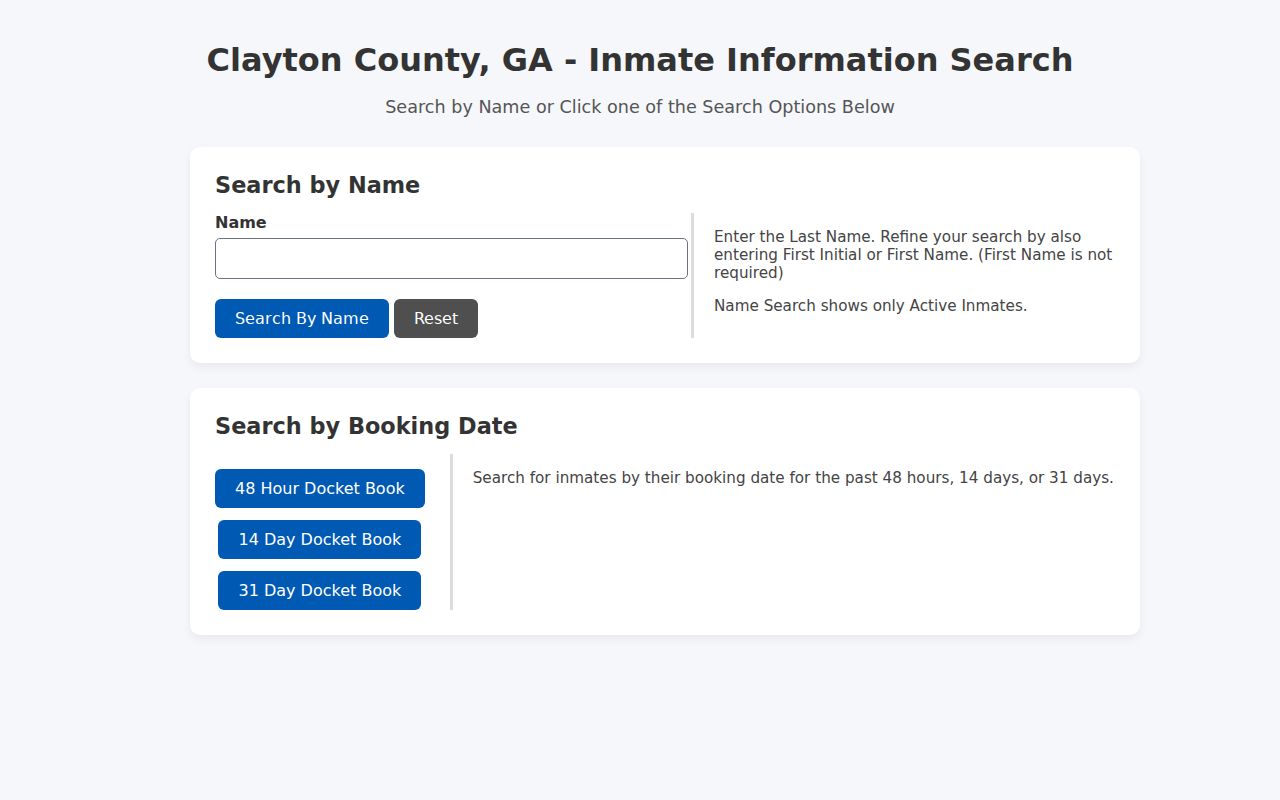
A Clayton County name result and a detention window still need checking against the issuing court before anyone relies on them.
Clayton County Warrant Types
Clayton County works with several kinds of judicial process. An arrest warrant follows a judge's probable-cause finding. A bench warrant enforces a missed appearance or other court order. A search warrant authorizes a search, not an arrest. City courts issue their own process after a missed traffic or ordinance case, and the reason for issuance points to the right court and next step.
| Warrant Type | How It Arises | Who Issues It |
|---|---|---|
| Arrest warrant | An allegation supported by judicial probable cause | Magistrate or another authorized court |
| Bench warrant | A missed hearing, contempt, or failure to follow an order | The judge handling that case |
| Search warrant | Probable cause to search a person, place, or property | An authorized judge |
| FTA warrant | A failure to appear or resolve a citation | State or municipal court |
Clayton Courts Route Different Warrants
A Clayton County warrant search can cross several desks. Superior Court handles felonies and other broad-jurisdiction cases. State Court takes misdemeanors and traffic. Magistrate Court issues criminal arrest and search warrants, sets bond on most criminal charges, and conducts preliminary hearings, while municipal courts control city traffic, ordinance, and qualifying misdemeanor matters. The Harold R. Banke Justice Center, 9151 Tara Boulevard in Jonesboro, puts many of these offices under one roof. Sharing a building does not merge their files. The official floor directory maps each counter. Superior Court clerk questions go to 770-477-3395 or the criminal and civil line at 770-477-3405. State Court lists 770-430-6911, with traffic at 770-477-3386, and the Magistrate Clerk lists 770-477-3443.
Magistrate Court Criminal Division
Harold R. Banke Justice Center, second floor
9151 Tara Boulevard, Jonesboro, GA 30236
770-477-3443
Clayton's Banke Justice Center
The Banke Justice Center opened in 2000. It combines court, sheriff, detention, and support functions in one Clayton County complex. Its 18 courtrooms and many public counters make the complex a common first stop. The right floor still depends on the record. A State Court traffic question does not move to Magistrate Court just because both offices share an address. The detention facility is not the clerk for a Superior Court case. Building hours and filing windows differ too. The front door may open before a specific clerk starts taking citizen warrant applications. Magistrate Court's criminal function serves law enforcement around the clock. Public warrant application filing uses narrower published weekday periods. Check the Clayton County office and its hours before you travel. For routing, use the county's Banke floor directory. Bring identification, plus the case, citation, or warrant number if you have one. If an active warrant may exist, get legal advice before entering a Clayton County building that houses law enforcement and detention operations.
Inside a Clayton County Warrant Record
Fields vary by source. Clayton County's blank criminal arrest-warrant form records the applicant, the person sought, the alleged offense, incident facts, report details, witnesses, and a judge's probable-cause decision. A jail entry looks different. It tracks custody, charges, court process, and release or bond labels. The sheriff's official results interface shows the custody columns.
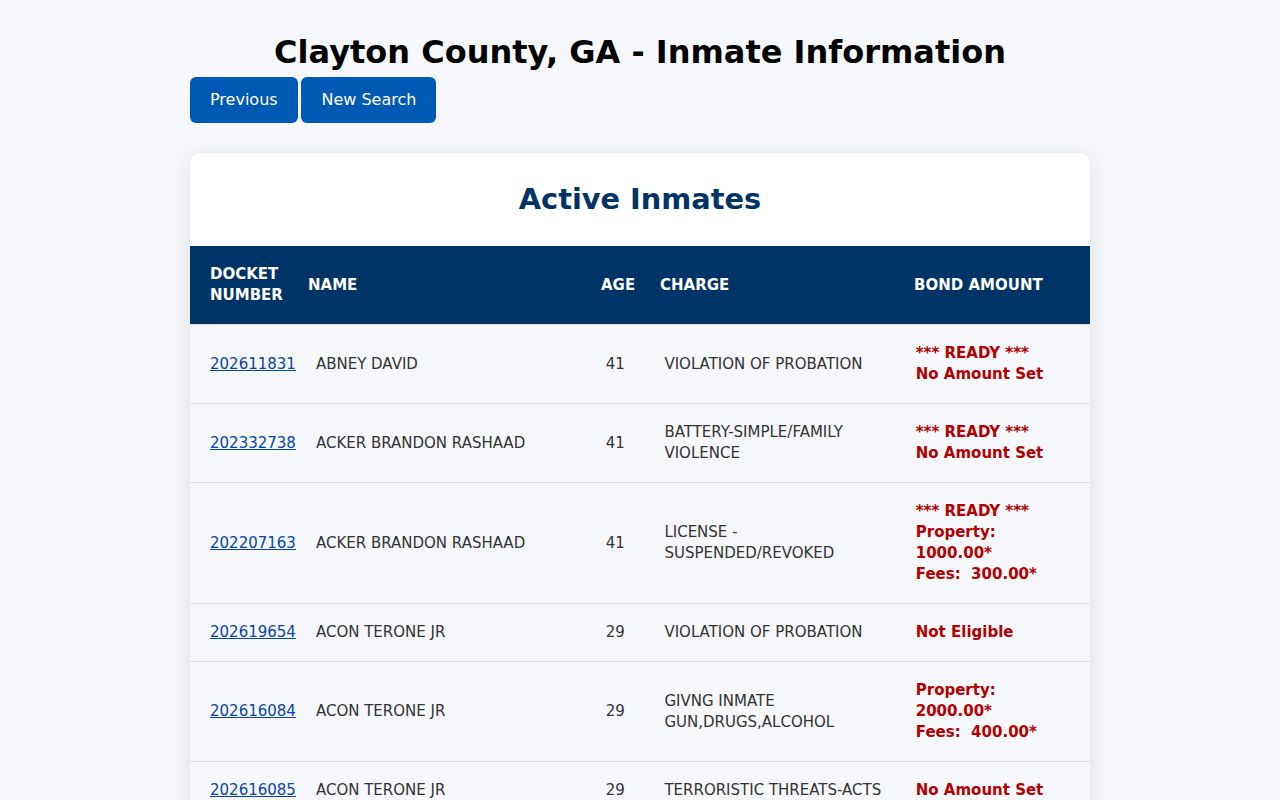
Those columns describe a jail record in Clayton County. The issuing clerk keeps the warrant file itself.
| Case or warrant number | An office identifier, such as court case number, used for clerk confirmation |
|---|---|
| Subject name | The legal name that must be checked against another identifier |
| Charge or offense | The allegation or court matter, not a finding of guilt |
| Issuing court | The court with authority to confirm, recall, or change its process |
| Bond amount | A displayed amount or labels such as No Amount Set and Not Eligible |
| Status | Active, served, recalled, or another term that needs direct confirmation |
Clayton County Bond Labels
The Clayton County jail docket can display bond labels. Ready marks a displayed release state. No Amount Set means no bond sum appears. Not Eligible shows the displayed release category is unavailable, and the label alone does not resolve the case. Property and cash bonds follow separate procedures, and the docket warns that added fees may not appear online.
- Bond
- A release condition while the criminal case continues.
- Recall
- A court action that removes or suspends enforceability of its warrant.
- Disposition
- The recorded outcome or later action in a case.
- First appearance
- An early hearing about charges, rights, counsel, and release.
Call Magistrate Court or the sheriff to confirm the current bond amount and where it must be paid. Clayton County routes Magistrate calls to 770-477-3443 and 770-477-3444. Sheriff and jail routing uses 770-477-4479 and 770-477-4441. Posting bond wins release, but the charge stands and future court dates still apply.
Issuing and Serving Warrants in Clayton County
Judges issue warrants. Law enforcement serves them. In Clayton County, Magistrate Court's criminal division takes arrest-warrant applications, weighs probable cause, and issues criminal arrest and search warrants, while Superior, State, Juvenile, and municipal judges may issue process within their own cases. The Clayton County Sheriff's Office serves or holds county process and runs the detention docket. City police may act on city warrants. The county's official sheriff landing page is the route into jail and public-safety services.
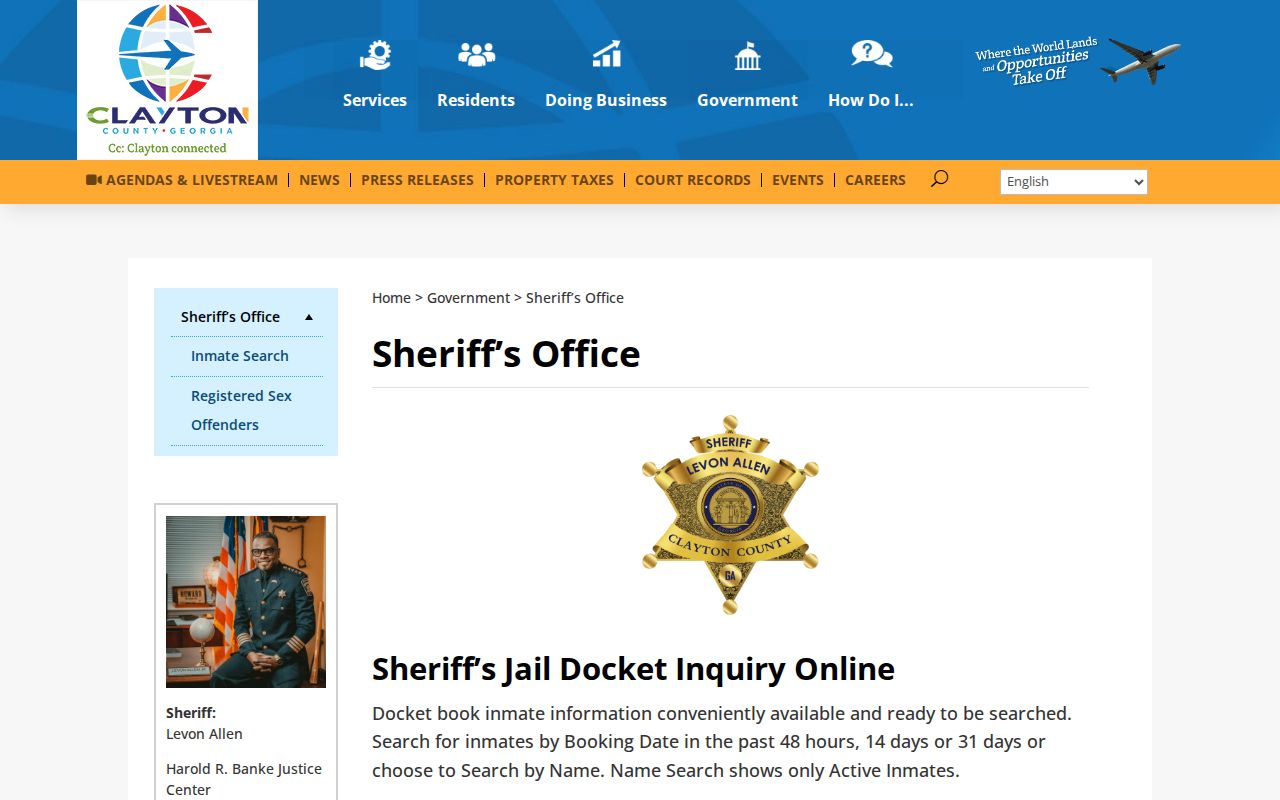
That page helps with custody checks. It is not warrant confirmation from the clerk. The split between the two offices matters for anyone checking a Clayton County warrant. Sheriff staff can say whether someone is in custody or whether a warrant was served, but only the issuing court can confirm what the judge ordered or whether that court recalled the warrant. Juvenile bench and pick-up orders may be restricted besides. Check the court name on the case record first.
Clayton County Sheriff's Office
9157 Tara Boulevard
Jonesboro, GA 30236
770-477-4479
Clayton Arrest-Warrant Applications
Clayton County residents can ask Magistrate Court to consider an arrest warrant against someone, but the process is strict. You need a police report. Bring valid picture identification and file in person. Each accused person requires a separate application, and the published fee is $20 per person unless an official exception applies. Notice and a hearing come first. Under the stated process, the hearing is scheduled no sooner than two weeks out, and the judge decides only after it. The form wants detail. Expect to give an incident narrative, the location and date, police report information, witness details, and descriptors of the person sought. Filing is not issuance. You cannot meet privately with the judge beforehand. The clerk gives no legal advice either. Use the current Magistrate Court instructions to verify hours and requirements. That application page covers the form and process, not a roster of issued warrants.
If You Have a Warrant in Clayton County
Start with the facts. Confirm the issuing court, the case number, whether the warrant is still active, and whether an appearance is mandatory. A missing web entry proves nothing, and neither does an unsolicited payment demand. A Georgia lawyer can arrange a voluntary appearance or surrender in Clayton County, handle bond, or move the issuing court to recall or quash the warrant. Recall means the court withdraws its process. Quash means a judge sets it aside by court order. Municipal cases follow city rules. Riverdale requires full payment and a contempt process before recall, while Jonesboro and Lovejoy lay out different steps for missed appearances. A Clayton County arrest warrant may instead lead to booking, first appearance, bond, and a preliminary hearing. Keep every receipt, disposition, and recall order.
Important: Speak with a lawyer and the issuing court before appearing in person because an active warrant can result in immediate detention.
Clayton County Warrant Workload
Budget books deserve care here. Read them as workload, not a roster. The FY2025 budget reports 2022 activity of 4,547 arrest warrants, 278 criminal pre-issuance warrants, 1,118 search warrants, 24,083 warrants issued, 21,776 first appearances, and 9,555 preliminary hearings. Those figures come from one stated source year. They are not a single total, and they do not show how many Clayton County warrants are active today.
The proposed FY2026 budget carries more recent counts. It reports 15,334 warrants received and served or cleared in FY2024, and 18,094 for unaudited FY2025. Those figures do not prove every warrant went online. A 2025 Magistrate Court clearance-rate award is an operating milestone for Clayton County, not a live warrant roster.
Clayton County Warrant Records and Public Access
Georgia's Open Records Act opens most agency records. A statute, court order, or exemption can still limit what an agency releases. So ask for an existing releasable record. No office must build a countywide compilation on request. Court files are generally public under Uniform Superior Court Rule 21, though sealed material, protected identifiers, and juvenile records may remain restricted in Clayton County.
Key Rules:
Georgia Open Records Act permits inspection and copying unless a legal limit applies.
O.C.G.A. § 50-18-71 supports Clayton County's designated open-records officer and request route.
Uniform Superior Court Rule 21 allows limits on court-record access when law or a court order requires them.
Delays can happen. A Clayton County agency may respond with an estimate of the time and authorized cost before producing records. If access is denied, request the exemption citation. A records response can lag the court's live status, so confirm whether the issuing court still considers the warrant active.
Clayton City Warrants Can Escalate
A missed court date in a Clayton County city can snowball fast. The clerk logs the failure to appear. Then a judge may tack on contempt or sign a bench warrant, and a traffic case can put Georgia driving privileges at risk. Paying later does not always mean the warrant is gone. The court may want a new date, signed papers, or a separate withdrawal notice sent to the Georgia Department of Driver Services. Each city in Clayton County sets its own rules. Riverdale lists a $150 contempt charge and demands full payment before its recall process even starts. Jonesboro warns that one missed date can bring contempt, a bench warrant, and a license suspension. Lovejoy notes that paying may still leave a mandatory appearance or an FTA withdrawal step. Forest Park and Morrow take payments but make you confirm status with them directly. Lovejoy and Jonesboro have run amnesty events before, proving temporary recall terms exist. Both expired. Treat an old event as closed unless that city says otherwise.
Clayton County Warrants by City
Municipal courts in Forest Park, Riverdale, Lovejoy, Morrow, and Jonesboro handle city traffic and ordinance cases, and a missed date can bring a warrant from any of them. For Clayton County residents facing a municipal warrant, the city clerk is the right first call. City police can route non-emergency questions, while the county sheriff docket only shows who is in custody now. The five cities below appear in 2020 Census population order.
Forest Park Warrant Search
19,932 · Municipal court, police, payment, and city records routes
Riverdale Warrant Search
15,129 · Detailed missed-date, contempt, and disposition rules
Lovejoy Warrant Search
10,122 · Dedicated city warrant and FTA instructions
Morrow Warrant Search
6,569 · City Hall court, police, and open-records channels
Jonesboro Warrant Search
4,235 · City Center court, FTA, and mandatory-appearance details